
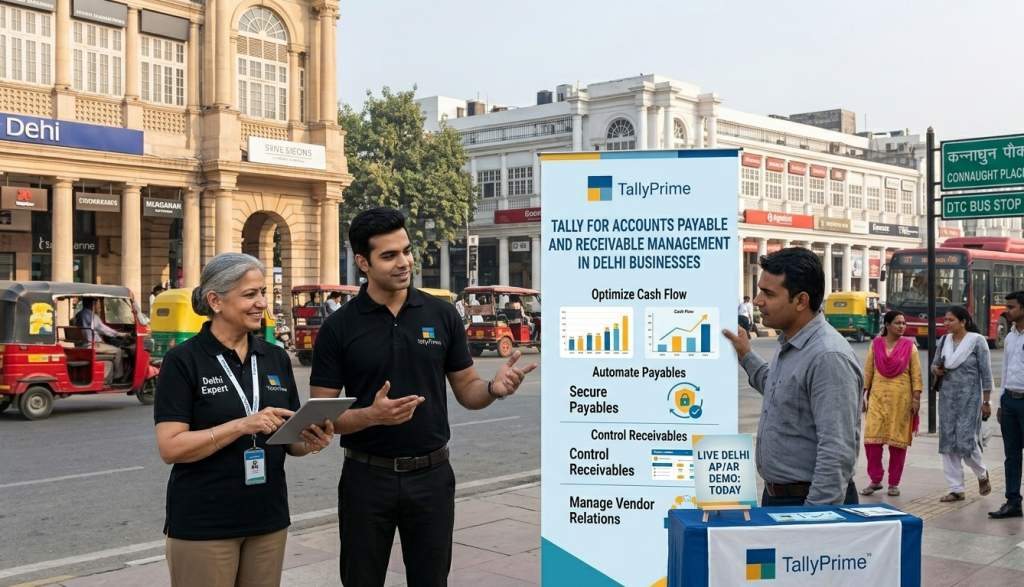
Tally for accounts payable and receivable management in delhi businesses
The efficient management of cash flows is the base of all successful businesses. In a highly dynamic environment like that of delhi, where businesses operate with many different customers, vendors, and with a high number of credit cycles, managing accounts payable (AP) and accounts receivable (AR), become increasingly important.
While many businesses are able to track outstanding payments, determine the limits of customer credit, and collect outstanding payments in an acceptable timeframe, there are many businesses that struggle with the process. The need for an automated method for the management of accounts payable and accounts receivable has led to the development of TallyPrime.
Within this article we will discuss how TallyPrime enables delhi businesses to automate and enhance the management of accounts payable and receivable, as well as provide improved cash flow and minimize financial risk.
Understanding Accounts Payable and Receivable
Before we delve into the specifics of Tally’s ability to assist in the management of accounts payable and accounts receivable, it is beneficial to first gain an understanding of these two key concepts.
Accounts Payable (AP)
Accounts payable represents the money owed to a company’s vendors or suppliers. In addition to representing money owed to vendors or suppliers, accounts payable also represents the amount of money that a business owes for goods or services purchased. Accounts payable represents short-term liabilities.
Accounts Receivable (AR)
Accounts receivable represent the amount of money that a company’s customers owe. In addition to representing the amount of money that a company’s customers owe, accounts receivable also represents the amount of credit that was extended to customers through the sale of goods or services on credit. Accounts receivable represents monies that are expected to be paid to a company through the receipt of payments of outstanding invoices.
Proper management of both accounts payable and accounts receivable will result in the following benefits:
- Improved cash flow
• Strengthened relationships with vendors
• Reduced financial stress
Challenges That Delhi Businesses Face When Managing Accounts Payable and Accounts Receivable
Delhi businesses face the following challenges when managing accounts payable and accounts receivable:
- Difficulty in tracking multiple outstanding invoices.
• Delayed payments from customers.
• Missed vendor payment deadlines.
• Lack of transparency in regards to the status of accounts receivable and accounts payable.
• Manual errors in calculations.
• Inefficient follow up procedures.
Previous methods used for the management of accounts payable and accounts receivable, such as spreadsheets and manual bookkeeping, are no longer viable options for meeting today’s complex needs.
How TallyPrime Can Assist Delhi Businesses in Managing Accounts Payable and Accounts Receivable
TallyPrime is a comprehensive system designed to enable companies to efficiently manage their debtors and creditors.
Bill-Wise Tracking System
Bill-wise tracking is one of the most powerful features of TallyPrime.
What It Does:
- Each invoice is tracked individually.
- Payments are linked to specific bills.
- The accuracy of outstanding balances is maintained.
Benefits: - There is no confusion regarding outstanding payments.
- Visibility of each transaction is provided.
- Financial control is enhanced.
Instantaneous Outstanding Reports
Instantaneous access to the following reports is available via TallyPrime:
- Reports on accounts receivable.
- Reports on accounts payable.
- Details of ledger-wise outstanding.
- Why It Matters:
Business owners in Delhi can:
- Monitor the status of their outstanding dues in real time.
- Identify overdue payments.
- Take immediate action.
Aging Analysis Reports
Aging reports are necessary for effective management of receivables.
Tally Features:
Aging reports categorize outstanding amounts by the length of time they have been outstanding.
Examples include:
0–30 days
30–60 days
60+ days
Benefits:
Identify long-pending dues.
Collections are prioritized.
Bad debts are minimized.
Credit Limit Management
Effective management of a customer’s credit limit is necessary to prevent excessive financial risk.
TallyPrime Enables You To:
Establish credit limits for each of your customers.
Establish the period of credit for each of your customers.
Receive notifications when a customer exceeds the established credit limits.
Results:
Improve your control over credit.
Minimize the risk of payment default.
Automated Payment Reminders
Follow ups can be a significant burden and often occur inconsistently.
With Tally:
Due dates are tracked automatically.
Automatic reports are generated to facilitate follow up.
Automatic notifications are sent to customers.
Automated payment reminders improve collection efficiency and cash flow.
Seamless Invoice Management
Invoices are the foundation of the AP/AR cycle.
Tally Features:
GST compliant invoicing.
Automatic creation of invoices.
Linkage of invoices with payments.
Benefits:
Accurate invoicing.
Accelerated payment cycles.
Reduced disputes.
Multiple User Access and Control
As growing businesses in Delhi expand, it is common for various employees to be responsible for managing the accounts.
Tally Offers:
Role-based access control.
Distinct permissions for employees.
Protection of data.
Employees are held accountable for their actions.
Errors are minimized.
Integration with Banking and Reconciliation
TallyPrime makes it easier to monitor payments through integration with banking features.
Key Features:
- Reconciliation of bank.
- Tracking of payments.
- Matching of invoices with transactions.
- Consequence:
- Accuracy of financial records.
- Optimized cash flow management.
Advantages of Using Tally for Accounts Payable and Receivable for Delhi Businesses
The use of TallyPrime for the management of accounts payable and accounts receivable has several advantages for Delhi businesses:
- Improved Cash Flow Management.
- Faster Collections.
- Timelier Payments to Vendors.
- Better Liquidity.
- Reduced Manual Errors.
Automation leads to fewer errors in calculation.
Fewer duplicate entries.
Less data inconsistency.
Improved Financial Transparency.
Real-time insight into business operations allows businesses to:
- Effectively plan their finances.
- Make informed decisions.
- Avoid cash shortages.
- Enhanced Vendor and Customer Relations
The timely payment of invoices strengthens the relationship with vendors.
The timely issuance of invoices improves the quality of service provided to customers.
• Compliance and Accuracy
TallyPrime generates GST-compliant invoices which results in:
- Accurate tax filings.
- Lower compliance risk.