
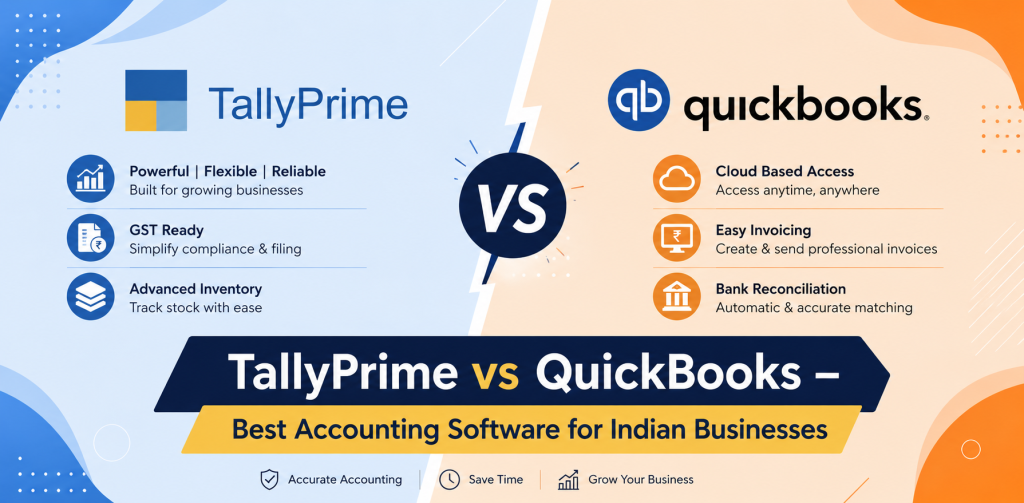
TallyPrime vs QuickBooks – Best Accounting Software for Indian Businesses
When selecting accounting software, Indian businesses (particularly SMEs) need to consider the importance of reliable financial data, timely GST compliance, efficient inventory tracking, and effective reporting. Two of the top accounting software choices for SMEs in India include TallyPrime and QuickBooks. In this report, we compare TallyPrime and QuickBooks to help Indian businesses select the best accounting software based on their compliance requirements, costs, and feature requirements.
WHY CHOOSE THE RIGHT ACCOUNTING SOFTWARE?
Indian businesses (especially SMEs) benefit from using the correct accounting software because it:
- Helps maintain accurate financial records for tax compliance purposes
- Helps track income, expenses, and cash flow efficiently
- Generates MIS (Management Information System) and statutory reports to assist in making informed decisions
- Automates routine processes such as invoicing, payroll processing, and GST submissions
- Facilitates scalability as business activities increase
India’s GST law and specific statutory laws necessitate the selection of an accounting software that complies with all applicable Indian laws and regulations.
OVERVIEW OF TALLYPRIME
TallyPrime is the most commonly used accounting software in India. The reason for its popularity lies in its ability to be flexible and comply with Indian laws. TallyPrime includes:
- Accounting, inventory and payroll management
- Compliance with GST, TDS, and other statutory laws
- Ability to manage multiple companies and/or location
- Reporting capabilities and analysis (such as MIS, cost centers, and profitability)
Medium to large-sized businesses and organizations in India favor TallyPrime due to its capability to handle all aspects of accounting, inventory and taxation.
KEY FEATURES OF TALLYPRIME
- Features of Accounting & Finance Ledgers, Journals, Trial Balance, Balance Sheet, and P&L Reports
- Features of Inventory Management Real-time Inventory Tracking, Batch-wise and Location-wise Stock Management
- Features of Tax Compliance Automated GST Calculations, GSTR-1, GSTR-3B Filing, TDS, and E-Way Bill Integration
- Features of Payroll Employee Records, Salary Structure, Statutory Deductions
- Features of Banking Reconciliation of Banks, Payment, Receipts Management
- Features of Reporting & Analytics Reporting Features and Dashboards for Strategic Decision-Making
OVERVIEW OF QUICKBOOKS INDIA
QuickBooks India is the Indian version of QuickBooks, which is a well-known cloud-based accounting software. It is specifically designed for small and medium businesses. It is cloud-first and allows remote access and collaboration for tech-savvy SMEs. QuickBooks India also includes:- Accounting, Invoicing, Expense Tracking
- Compliance with GST and Statutory Laws
- Multi-Company Operations with User-Based Access
- Customizable Dashboards and Reports
KEY FEATURES OF QUICKBOOKS INDIA
Features of Accounting & Bookkeeping
Ledger Management, Journal Entries, Trial Balance, Financial Statements
Features of Invoicing & Billing
Quick Creation of GST Compliant Invoices Using Multiple Templates
Features of GST Compliance
Automated GST Calculations, Filing Support, E-Way Bill Generation
Features of Banking Integration
Connect with Indian Banks for Reconciliation
Features of Reports & Analytics
Profit & Loss, Balance Sheet, Customizable Dashboards
Features of Cloud Access
Mobile and Desktop Access with Remote Collaboration
QuickBooks is particularly appealing to start-ups and growing SMEs that value mobility, automation, and modern cloud-based applications.
TALLYPRIME VS QUICKBOOKS INDIA: COMPARISON OF FEATURES
Ultimately, the decision between TallyPrime vs QuickBooks will depend upon the size of your business, the level of accounting complexity, the extent of your GST requirements, and the type of reporting required.
Ease of Use
- TallyPrime: Easy to use with shortcut keys. Accountants familiar with the accounting workflow in India are able to quickly learn how to use TallyPrime.
- QuickBooks India: Modern interface; ideal for tech-savvy users. However, there may be some additional set-up work required to ensure seamless GST compliance integration.
- Winner: QuickBooks for a modern interface; TallyPrime for those who are familiar with traditional accounting workflows in India.
GST Compliance
- TallyPrime: Provides complete support for GST and statutory compliance. Widespread use by Indian businesses for statutory compliance.
- QuickBooks India: Includes support for GST invoicing and returns, however, it may be necessary to manually enter information for TDS and complicated GST scenarios.
- Winner: TallyPrime for complete India-specific statutory compliance.
Accounting & Finance
- TallyPrime: Provides a wide range of advanced accounting functions including multi-ledger support, cost centers and real-time financial reporting. Effective at managing complex accounting transactions.
- QuickBooks India: Appropriate for SMEs with relatively simple accounting needs. Multi-dimensional accounting is significantly more limited when compared to TallyPrime.
- Winner: TallyPrime for large or complex accounting operations; QuickBooks for simple accounting needs of SMEs.
Inventory Management
- TallyPrime: Offers strong inventory management capabilities including batch-wise tracking, multiple warehouse and real-time stock levels.
- QuickBooks India: Limited inventory management capabilities for small businesses; does not provide multi-location and batch tracking capabilities.
- Winner: TallyPrime for businesses that have complex inventory needs.
Reporting & Analytics
- TallyPrime: Provides comprehensive MIS reporting, dashboards and analytical capabilities. Highly beneficial for strategic decision-making and planning.
- QuickBooks India: Good dashboards and reporting for SMEs. Possible to customize, but less granular than TallyPrime.
- Winner: TallyPrime for detailed reporting; QuickBooks for easy-to-read summaries.
Scalability
- TallyPrime: Offers multi-company, multi location capabilities and compatibility with third party tools. Ideal for growing businesses.
- QuickBooks India: Most suitable for small to medium businesses; scalability limitations for larger enterprises.
- Winner: TallyPrime for scalability; QuickBooks for start-ups and small SMEs.
Cost
- TallyPrime: Larger upfront investment, but provides extensive features, multi-user support and long term reliability.
- QuickBooks India: Lower subscription fees for SMEs; lower cost of entry for small businesses.
- Winner: QuickBooks for budget-conscious SMEs; TallyPrime for businesses looking to invest in robust features over the long-term.
Accessibility & Cloud Features
- TallyPrime: Desktop-based primarily; remote access provided via Tally On Cloud services.
- QuickBooks India: Cloud first; accessible via desktop, mobile or tablet. Ideal for remote teams and multi-location collaboration.
- Winner: QuickBooks for mobility; TallyPrime for offline reliability.
Integration and Support
- TallyPrime: Compatible with payroll, GST, banking and ERP systems. Strong support base and training options in Delhi.
- QuickBooks India: Compatible with banking, invoicing and cloud applications. Online support; may require additional third party apps for advance features.
CHOOSING BETWEEN TALLYPRIME AND QUICKBOOKS INDIA
Indian businesses should choose TallyPrime if they:
- Require advanced accounting, inventory and multi-branch operations
- Need full support for GST and statutory compliance
- Require in depth MIS reporting and multidimensional analysis
- Prioritize long-term scalability
And, Indian businesses should choose QuickBooks India if they:
- Are a small business or start-up with simple accounting needs
- Desire cloud access, mobility, and subscription-based pricing
- Require basic GST compliance and invoicing
- Value ease of use and a modern interface