
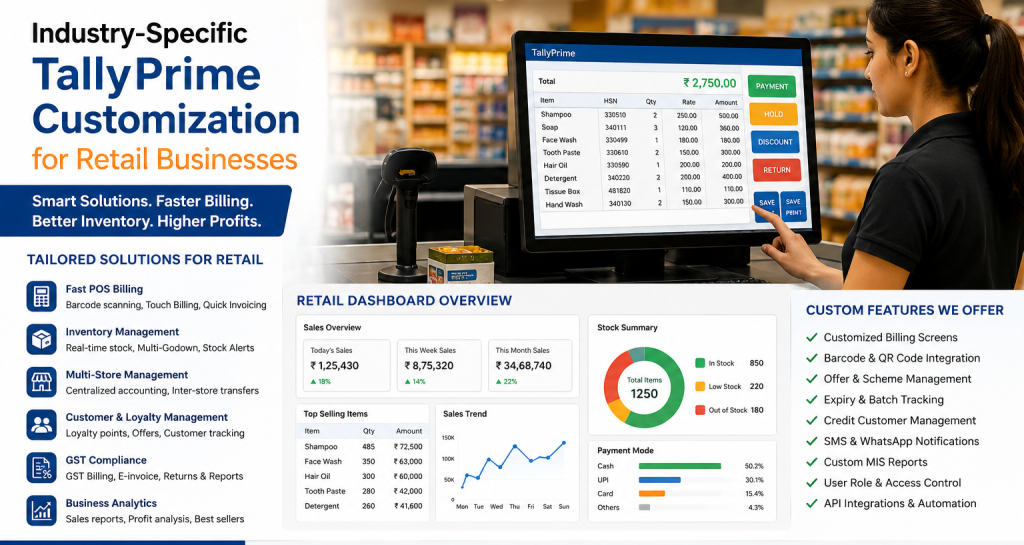
Industry-Specific Tally Customization for Retail Businesses in Meerut
Retail businesses in Meerut are undergoing rapid development based on rising consumer expectations and adoption of digital payments. Retail businesses in Meerut therefore require an efficient way to handle day-to-day activities. While Tally Prime has been adopted for many types of businesses for its standard accounting capabilities, it is also lacking in some aspects that are important for the retail industry.
Additional features such as POS integration, barcode management and retail reporting are examples of additional features that would be beneficial for a retailer. These additional features make industry-specific Tally customizations crucial for a successful operation. Our Tally retail customization Meerut service provides retail businesses with a means to simplify the process of handling day-to-day activities, improve the accuracy of those processes and provide a positive experience to consumers.
Why Retail Businesses Need Customized Tally Solutions
Although Standard Tally provides adequate functionality for general accounting, there are many unique characteristics of a retail business that cannot be addressed using Standard Tally.
Some examples of unique aspects of a retail business that require customized Tally solutions include:
- Daily high volume transaction processing
- Tracking of inventory across multiple products
- Use of barcodes for scanning and billing
- Point of sale (POS) integration
- Real-time sales reporting
- Without a customized Tally solution, a retailer’s ability to successfully manage their day-to-day activities could result in inefficiencies and inaccurate information. Therefore, our Tally for shops Meerut solutions allow retailers to operate more efficiently and grow their businesses.
What is Tally Retail Customization?
The Tally retail customization refers to the enhancement of Tally Prime with additional features and interfaces that are tailored to the operational needs of a retail business.
In addition to the standard features provided by Tally Prime, our Tally POS Meerut and customized modules will provide your retail business with:
- The ability to seamlessly integrate your point of sale system with your accounting
- The ability to automatically update inventory levels when a sale is made
- Retail-specific reporting options
- Improved check out efficiency
Key Features of Our Retail Tally Customization Services
POS Integration
A point-of-sale (POS) system is a requirement for a majority of modern retail businesses. Our Tally POS Meerut solutions will allow you to:
- Complete fast and accurate billing
- Record sales in real-time
- Seamlessly integrate your POS system with your Tally accounting system
- Process multiple forms of payment
These improvements ensure a smooth shopping experience for your customers.
Barcode Integration
Barcodes are utilized to quickly identify products and improve both the speed and accuracy of your inventory and billing processes. In conjunction with Tally barcode Meerut, we offer:
- Generation and scanning of barcodes
- Identification and tracking of products
- Improved efficiency of billing and reduced errors
Inventory Management Customization
Retail businesses carry a diverse array of products. Our solutions will include:
Categorizing and grouping inventory
- Tracking inventory across multiple locations
- Managing expiration and batch dates
- Automatically updating inventory levels when sales occur
- Your business will always maintain an accurate view of your inventory
Retail-Specific Reporting
Most standard reporting options do not provide the insight necessary for making informed decisions in a retail environment. We create:
- Daily sales reports
- Reports showing profit per product
- Reports providing analysis of purchases by customers
- Reports detailing changes in stock levels
- These retail accounting software Meerut solutions will assist in improving your decision-making.
Multi-Outlet Management
For businesses with multiple store locations, we offer:
- Centralized management of company-wide data
- Reporting of branch locations
- Combined financial reporting
GST-Compliant Billing
All retail businesses must generate invoices compliant with GST regulations. Our customization will ensure that:
- You generate GST-compliant invoices
- Tax calculations are accurate
- Easily file returns for GST
Integration with Payment Systems
We integrate Tally with popular payment methods such as:
- UPI
- Credit/Debit Cards
- Digital Wallets
- This will increase the convenience for your customers and quicken the billing process.
Advantages of Tally Retail Customization
- Fast Billing Proces
By integrating your POS and utilizing barcodes, you can drastically shorten your billing process.
- Fast Billing Proces
- Improved Inventory Control
By tracking your inventory levels in real-time, you can avoid stock shortages and overstocking.
- Improved Inventory Control
- Enhanced Consumer Satisfaction
Billing quickly and accurately will contribute to increased consumer satisfaction.
- Enhanced Consumer Satisfaction
- More Accurate Financial Reports
Retail-specific reports will provide clear insight into how well your business is performing.
- More Accurate Financial Reports
- Greater Efficiency
Automation of repetitive tasks will decrease the amount of manual labor and errors.
- Greater Efficiency
Why Meerut Retailers Should Utilize Tally Customization
The retail marketplace in Meerut is very competitive. Businesses can include everything from traditional retail stores to modern retail stores. Retailers need the following to remain competitive:
- Efficient billing systems
- Accurate inventory tracking
- Insight into your business at any moment in time
- Our Tally retail customization Meerut solutions will provide retailers the tools needed to meet these demands and to operate more efficiently.
Industries We Serve
Our Tally for shops Meerut solutions are best suited for a variety of industries such as:
- Clothing & Apparel Stores
- Store size, color and seasonal inventory management
- Electronics Shops
- Management of high value goods and warranty tracking
- Grocery & FMCG Stores
- Handling large volumes of transactions and stock movements
- Pharmacy Stores
- Management of batch numbers and expiration dates
- Furniture & Home Decor
- Management of custom orders and inventory
How We Customize Tally for Retail Businesses in Meerut
We follow a defined methodology to deliver a comprehensive retail accounting software Meerut solution that meets each client’s individual requirements.
Step 1: Requirements Gathering
Understanding the operational processes and challenges of your retail business.
Step 2: Solution Design
Designing a customized plan that addresses your specific needs.
Step 3: Development
Development and implementation of customized features and integrations.
Step 4: Testing
Verification of correct functioning and performance of the developed features and integrations.
Step 5: Deployment
Implementation of the customized solution within your system.
Step 6: Training & Support
Training of your employees on usage of the new customized solution and ongoing support.
Challenges That We Can Solve Using Our Tally Customization Solutions for Retail Businesses in Meerut
Retail businesses in Meerut encounter many common challenges related to:
- Slow billing
- Inventory discrepancies
- Lack of detail in reporting
- Manual errors
- Our Tally POS Meerut and customization services will solve these problems efficiently.
Why Use Our Company for Your Tally Customization Needs in Meerut?
-
-
- ? Retail Business Expertise
- We are knowledgeable about the operational needs of retail businesses.
- ? Customized Solutions
- Features and integrations that are tailored to your business model.
- ? Fast Implementation
- Minimal disruption during fast and reliable deployment.
- ? Long-Term Ongoing Support
- Reliable and ongoing support and maintenance of your customized solution.
- ? Economical Service Options
- Cost-effective customized solutions for small and medium sized retailers.
-
The Future of Retail with Tally Customization
As retail businesses in Meerut increasingly use digital technologies, the importance of customization will grow further. Some of the ways in which customization will positively impact the future of retail include:
-
-
- Omnichannel retailing
- Enhanced business intelligence through advanced analytics
- Automated inventory management systems
- Integr111ation of e-commerce platforms
- To prepare your retail business for this technological shift, investing in customized Tally solutions such as Tally barcode Meerut and POS will be imperative.
-
Conclusion
Retail businesses in Meerut require more than the basic accounting functions of a standard accounting software to compete in today’s competitive retail market. With industry-specific Tally customization, retail businesses in Meerut can streamline their operations, operate more efficiently and provide a higher quality experience to their consumers.
Our Tally retail customization Meerut solutions include complete solutions for POS integration, barcode support and retail-specific reporting. Whether you are operating a small store or a multi-unit retail chain, customized Tally solutions will assist you in optimizing your business operations.
If you wish to improve the operational efficiency of your retail business, now is the perfect time to invest in professional Tally for shops Meerut solutions and elevate your business to the next level.